
Actualización de productos
October 8, 2026
Solar Repowering in the Field: A Technical Playbook for Getting the Job Done Right

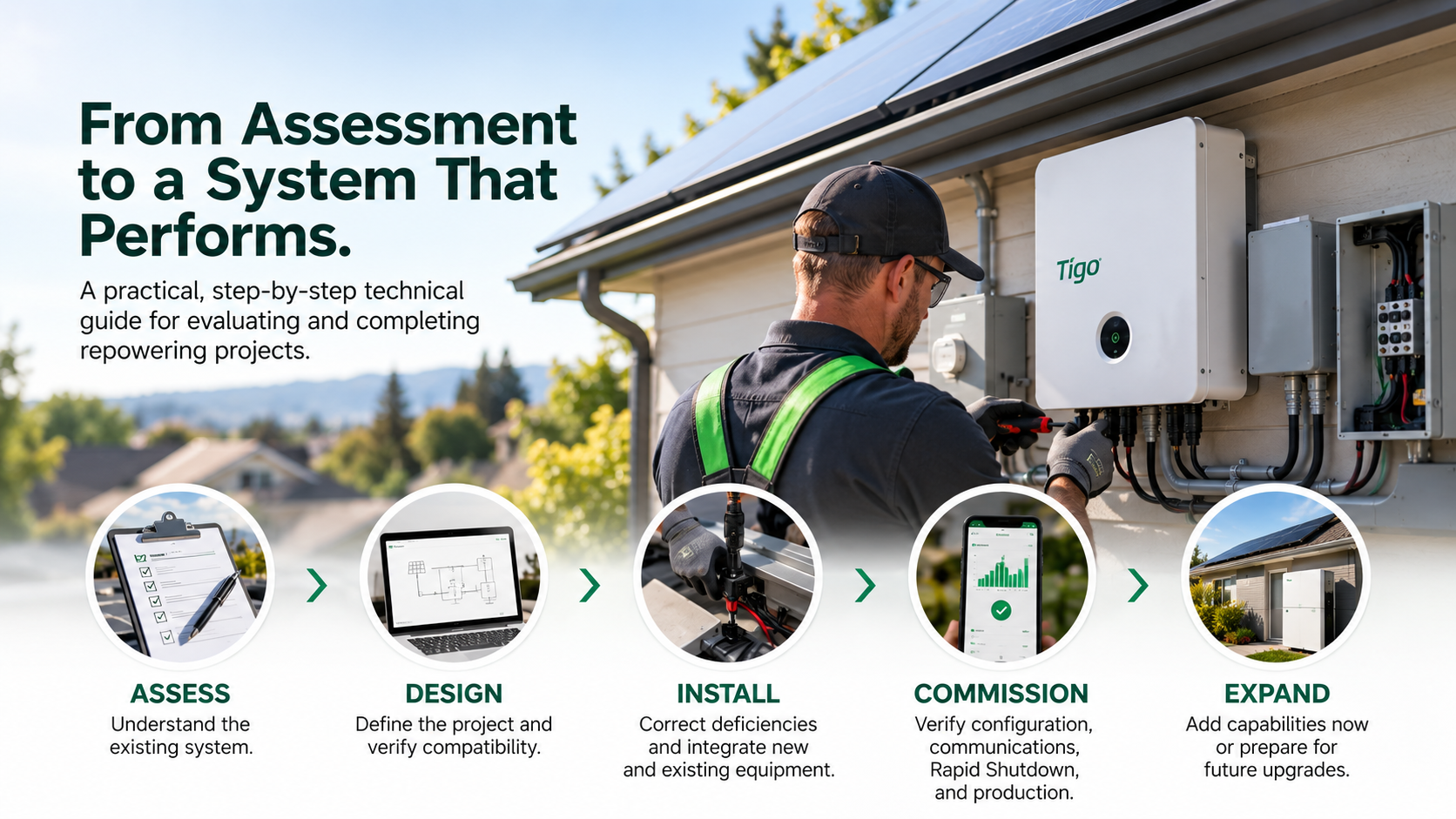



From the first site assessment through commissioning, the Tigo Repowering Technical Playbook gives installers a practical framework for evaluating and completing repowering projects.
It is designed as the technical companion to Tigo’s Repowering Playbook, which helps installers identify, package, sell, and manage repowering opportunities. Once that opportunity becomes a job, the Technical Playbook takes over with a field-focused process for evaluating the existing system, making the right technical decisions, completing the work, and verifying the result.
En resumen
- Repowering is different from new construction: you are working with an existing system, existing equipment, and often incomplete information.
- A successful repower starts with understanding what is actually on site before deciding what stays, what goes, and what gets added.
- The Tigo Repowering Technical Playbook walks installers through the technical process from assessment and design through installation, commissioning, and future expansion.
- It also includes practical field resources, including an MLPE decision flow chart and Repowering Field Assessment Worksheet installers can use on site.
Visit the Repowering Technical Playbook
Repowering Starts With What’s Already There
A new solar installation generally begins with a design. A repowering project begins with questions.
What equipment is actually installed? What failed? What can safely remain? Is the existing array electrically compatible with the replacement inverter? What condition are the conductors, connectors, grounding, MLPE, Rapid Shutdown equipment, and monitoring system in? And what needs to change before the system goes back into service?
That is why the first job on a repowering project isn’t replacing equipment. It’s understanding the existing system.
Older systems may have incomplete documentation, equipment that has been replaced over the years, or conditions that differ substantially from the original plans. The Technical Playbook helps installers build an accurate picture of the system using the evidence available on site before designing the solution.
A Practical Workflow From Assessment to Completion
The Technical Playbook follows a straightforward field workflow:
ASSESS → DECIDE → DESIGN → INSTALL → COMMISSION → EXPAND
At every stage, installers are encouraged to answer three questions: What must be evaluated? What decision must be made? Which technical resource supports the next step?
The goal is not to replace product manuals or engineering requirements. It is to give installers a repeatable process for approaching a repowering project and knowing what needs to happen next.
Assess What You Actually Have
Before specifying replacement equipment, document the existing system, review its condition, perform the appropriate electrical evaluation, and determine what still has value.
That assessment should lead to a technical decision: repair, repower, expand, or investigate further.
Design Around What Stays - and What Changes
Repowering rarely means replacing everything.
The design needs to clearly establish what stays, what goes, what gets added, what existing deficiencies must be corrected, and what is outside the project scope. Compatibility must then be verified rather than assumed.
That includes considerations such as string and MPPT design, MLPE and Rapid Shutdown architecture, communications, monitoring, interconnection, and battery readiness.
Install Without Carrying Old Problems Forward
Existing systems can contain years of history—and sometimes years of problems.
The Technical Playbook emphasizes documenting the existing installation before equipment is disconnected, correcting deficiencies rather than reproducing them, and then integrating new and existing equipment according to the approved design and current product documentation.
A repower is an opportunity to correct existing design problems, not reproduce them.
Commission the System - Don’t Just Turn It On
A powered inverter does not necessarily mean the repowering project is complete.
Commissioning should verify configuration, communications, device discovery, Rapid Shutdown operation, monitoring, and actual system production. If the design calls for 32 TS4 devices and only 31 are discovered, for example, the job isn’t finished yet.
The objective is simple: prove that the repowered system operates as intended before leaving the site.
Think Beyond Today’s Repair
A repowering project can also be an opportunity to prepare an existing solar system for its next phase.
That may mean adding storage now, preparing for a future Tigo GO Battery installation, expanding PV capacity, upgrading MLPE, or improving monitoring. Even when those upgrades aren’t part of today’s scope, planning for them during the repower can help avoid unnecessary rework later.
This is also where the technical and business sides of repowering reinforce each other. The Repowering Playbook helps installers turn service needs into clear customer options and a repeatable line of business; the Technical Playbook helps make sure those options are scoped, designed, and executed correctly in the field.
Built for the Installer in the Field
The Technical Playbook isn’t just an overview.
It includes practical resources installers can use when evaluating real systems, including a detailed MLPE Architecture Decision Flow and a two-page Repowering Field Assessment Worksheet for documenting existing equipment, site and safety conditions, array measurements, equipment considered for reuse, monitoring and communications, and the preliminary technical path forward.
That means your team can use the same framework from the initial site visit through the final technical handoff.
The Technical Repowering Mindset
If there are three things to remember before your next repowering project, they are:
Don’t assume the existing system is correct.
Don’t reuse equipment until compatibility is verified.
Don’t leave until safety, communication, and production are verified.
The business opportunity around repowering is growing—but capturing that opportunity requires being able to execute the work consistently once your technician arrives on site.
Used together, the two playbooks cover both sides of repowering: the Tigo Repowering Playbook helps installers create and manage the opportunity, while the Tigo Repowering Technical Playbook helps execute it correctly in the field.
Building the business side too? Explore the Tigo Repowering Playbook for guidance on identifying opportunities, packaging services, selling repowering, and building a repeatable growth strategy.
Ready for Your Next Repowering Project?
Download the Tigo Repowering Technical Playbook for the complete assessment-to-commissioning workflow, field assessment worksheet, MLPE decision flowchart, and links to additional technical resources.
